
Logo

Scan to BIM Transform Point Cloud Data Into Intelligent Models

Converting 3D laser scanning data into accurate, intelligent Building Information Models is essential for modern construction projects. AJ Digital's scan to BIM services bridge the gap between physical reality and digital precision, delivering Revit models you can rely on from day one.

Get in touch today for a free consultation


From raw data to reliable models: The AJ Digital approach

AJ Digital takes raw point cloud data and transforms it into intelligent, actionable Building Information Models. We apply real-world coordinates to ensure perfect alignment with your existing plans, enabling seamless integration with other digital platforms used in construction and facility management. Our scan to BIM services are designed to empower clients at every stage of the entire building lifecycle. This is how we deliver that technology.

What is scan to BIM?

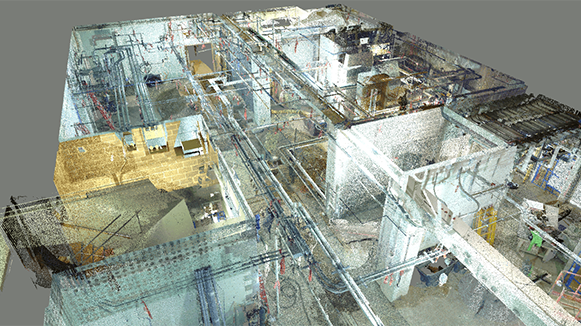
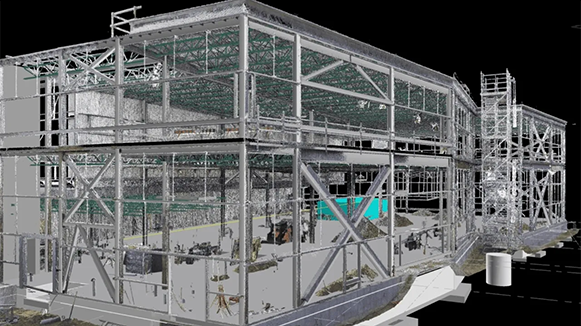
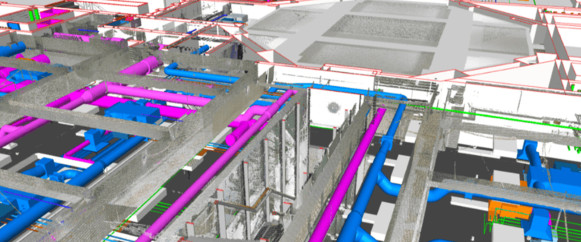
Scan to BIM is the process of transforming 3D laser scanning data, captured as millions of precise points called a 'point cloud' into detailed Building Information Models. Unlike traditional 2D drawings, these intelligent models integrate architectural, structural, and MEP elements into a single, spatially accurate digital representation. 

The result is a central hub of information that supports your entire project lifecycle, from design and planning through to construction, operation, and maintenance.

Get in touch today for a free consultation

Why scan to BIM matters

Traditional survey methods struggle to capture the full complexity of existing buildings, often missing critical details that lead to costly surprises during construction. Our point cloud to BIM services solve this challenge by providing millimetre-level accuracy, complete spatial understanding of complex conditions, and early clash detection before work begins. 

This means fewer site visits, reduced rework, and faster project delivery with the confidence that comes from working with reliable, verified data.

Get in touch today for a free consultation

Our Scan to BIM Process

We tailor our approach to your specific requirements, delivering models at any Level of Detail (LOD) from conceptual LOD 200 through to highly detailed LOD 500 for facilities management. Our team captures high-precision laser scans, processes the point cloud data with real-world coordinates, and converts it into intelligent Revit models complete with all architectural, structural, and MEP elements.

Every model undergoes rigorous quality assurance, validating dimensional accuracy against the original scan data and performing clash detection to identify spatial conflicts. We deliver your scan to BIM model in industry-standard formats, fully compatible with UK BIM standards including ISO 19650, accompanied by comprehensive documentation and ongoing support throughout your project.

The key benefits of our scan to BIM service

Faster, more confident decision-making

Millimetre-accurate data and complete spatial understanding means fewer site visits and accelerated project timelines with reliable information.

Reduced risk and costly rework

Early identification of design clashes and site constraints prevents costly surprises during construction, eliminating expensive rework.

Seamless collaboration across disciplines

A single, accurate model becomes the central hub for architects, engineers, contractors, and facility managers, fostering clear communication throughout the project lifecycle.

Why Choose AJ Digital for Your Scan to BIM Needs?

Our experienced team combines cutting-edge 3D laser scanning technology with deep expertise in BIM modelling to deliver bespoke solutions tailored to your exact needs. We do not force you into standardised packages, instead, we adapt our scan to BIM services to match your specific LOD requirements, timeline, and budget, ensuring seamless integration with your existing workflows.

Experienced BIM modellers: Our skilled technicians combine deep Revit expertise with the ability to accurately interpret complex point cloud data across diverse project types.

Flexible LOD delivery: From conceptual LOD 200 models for feasibility studies to detailed LOD 500 models for facilities management, we deliver exactly what your project needs.

Rigorous quality assurance: Every model is validated against the original scan data with comprehensive clash detection before delivery, ensuring dimensional accuracy you can trust.

UK standards compliance: Full alignment with ISO 19650 and BIM Level 2 requirements means your models are ready for regulatory handover and collaborative working.

  • What is scan to BIM used for?

    Scan to BIM is used to create accurate digital models of existing buildings and structures from 3D laser scan data. It is commonly used for refurbishment and retrofit projects, clash detection, design coordination, facilities management, and building lifecycle documentation. Any project that requires a reliable as-built record of an existing structure can benefit from the process.

  • How does the scan to BIM process work? 

    The scan-to-BIM process involves three key stages: first, 3D laser scanning captures point cloud data of the existing structure; second, this data is processed and cleaned to remove noise and align multiple scans; third, specialized software converts the point cloud into parametric BIM objects in platforms like Autodesk Revit. The result is an intelligent 3D model containing both geometry and metadata for construction planning, design coordination, and facility management.

  • What Level of Detail (LOD) do you provide in BIM models?

    At AJ Digital, we provide BIM models at various Levels of Detail from LOD 3 (conceptual) to LOD 6 (as-built), depending on project requirements. LOD 3-4 is typically used for design development and coordination, LOD 5 for fabrication and construction, and LOD 5-6 for facility management and maintenance. We tailor the LOD to match your specific project needs and intended use of the model.

  • How does scan to BIM differ from a traditional measured survey?

    A traditional measured survey captures key dimensions manually and produces 2D drawings. Scan to BIM captures the full geometry of a building in three dimensions, producing an intelligent model that contains far more spatial information. This makes it easier to identify clashes, coordinate across disciplines, and support decision-making throughout the project lifecycle.

  • Does a scan to BIM model comply with UK BIM standards?

    A properly produced scan to BIM model can be fully compliant with ISO 19650 and BIM Level 2 requirements. This means it can be used for collaborative working, regulatory handover, and integration with other project information, which is increasingly expected on UK public and commercial construction projects.

Top